Key Takeaways
- Quantization converts an existing model's weights to lower precision (typically FP32 to INT8); distillation trains a new, smaller model to mimic a larger teacher — different mechanisms, same goal of cheaper inference.
- INT8 quantization cuts model size and compute roughly 4x versus FP32 (Jacob et al., Google, 2017) and can be applied in hours with no retraining via post-training quantization.
- Knowledge distillation (Hinton et al., 2015) produced DistilBERT: 40% smaller than BERT, 97% of its language understanding retained, and 60% faster (Sanh et al., Hugging Face, 2019).
- Gartner forecasts AI inference costs per agentic workflow will increase more than fivefold through 2028, making inference optimization a budget priority, not just an engineering nicety.
- Start with post-training quantization as a low-effort first step; reach for distillation when you need a genuinely smaller architecture for edge or mobile deployment and can invest in a training run.
Distill First, Then Quantize
Gartner forecasts that AI inference costs per agentic workflow will increase more than fivefold through 2028, as inference — not training — becomes the dominant AI cost center for most businesses running models in production. Will Sommer, Senior Director Analyst at Gartner, put it bluntly in the firm’s August 2026 forecast: “Product leaders cannot rely on more efficient token economics to rationalize AI costs… Ensuring ROI from advanced AI … demands … highly optimized inference-tiering, routing and orchestration to calibrate complex tasks relative to more cost-efficient intelligence.”
Two techniques dominate how engineering teams actually deliver that optimization: model quantization and knowledge distillation. Both shrink the computational footprint of a deep learning model, but they work through entirely different mechanisms and come with different cost, speed, and accuracy tradeoffs.
This guide breaks down how each technique actually works, compares them on the dimensions that matter for a production deployment, and gives a decision framework for which one — or which combination — fits your situation.
What Is the Difference Between Quantization and Distillation?
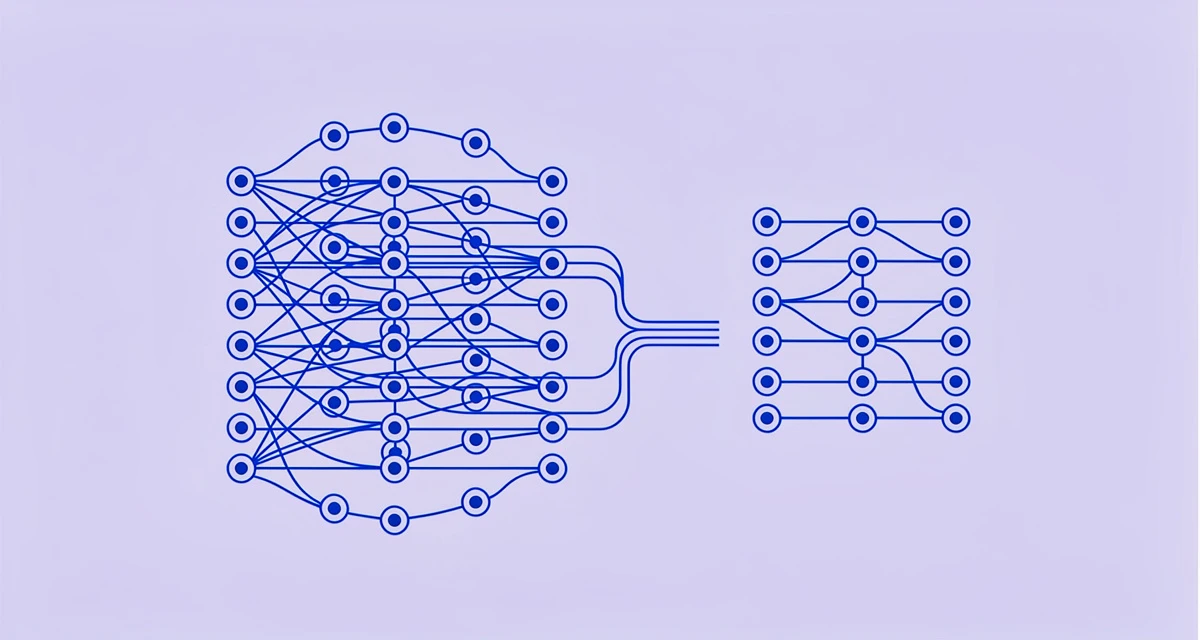
Model quantization reduces the numerical precision of an existing model’s weights, typically converting 32-bit floating-point numbers to 8-bit integers, without changing the model’s architecture. Knowledge distillation trains an entirely new, smaller “student” model to mimic a larger “teacher” model’s outputs. Both aim for the same outcome: cheaper, faster inference with minimal quality loss.
Quantization works like compressing a high-resolution image into a smaller file without changing what the image shows — the same architecture, represented with fewer bits per number. Distillation works more like a junior specialist studying a senior specialist’s decisions closely enough to reach similar conclusions with a leaner process: a new, smaller model trained specifically to reproduce the larger one’s behavior.
These techniques are not mutually exclusive. Production teams frequently combine them: distill a large teacher model into a smaller student architecture first, then quantize that student model to INT8 or lower for maximum compression. Each technique also has its own sub-variants — vision transformers and convolutional networks can be quantized or distilled using the same core principles as language models.
Neither technique is a substitute for choosing the right architecture in the first place. A poorly suited model compressed aggressively still performs worse than a well-suited model compressed lightly — quantization and distillation optimize an existing design choice, they don’t fix a bad one.
How Does Model Quantization Actually Reduce Inference Cost?
Model quantization reduces inference cost by lowering the precision of the numbers representing a network’s weights and activations. This shift from high-precision floating-point formats to lower-precision integer formats lets hardware perform simpler, faster arithmetic that consumes less memory bandwidth and energy per operation.
The most common implementation converts weights from 32-bit floating-point (FP32) to 8-bit integer (INT8) precision. According to Jacob et al.’s 2017 paper, “Quantization and Training of Neural Networks for Efficient Integer-Arithmetic-Only Inference,” INT8 quantization cuts model size and compute requirements by roughly four times compared to FP32. Modern AI accelerators run integer arithmetic natively, and storing weights in INT8 lets more of the model fit in cache, reducing the memory-access latency that bottlenecks inference. PyTorch’s quantization documentation implements this same INT8 workflow for production deployment.
Two paths get you there. Post-training quantization (PTQ) is applied after training finishes — it analyzes weight distributions and maps them to integer values with minimal engineering overhead, often in hours. Quantization-aware training (QAT) simulates quantization during training itself, letting the model adjust its internal representations to compensate for the coming precision loss. QAT costs more compute upfront but typically retains more accuracy than PTQ, especially at aggressive bit-widths below INT8 (4-bit or lower).
Quantization also splits into static and dynamic approaches. Static quantization calibrates weights and activations ahead of time using a representative sample of real data, producing the fastest inference but requiring that calibration step before deployment. Dynamic quantization converts activations on the fly during inference, skipping the calibration step at a small runtime cost — a useful shortcut when representative calibration data is hard to assemble.
The trade-off is compression versus fidelity. Quantization is cheap to apply, but pushing below INT8 can produce noticeable accuracy drops on tasks sensitive to numerical precision. For most enterprise applications, the modest accuracy cost of INT8 is a reasonable trade for the throughput gains and lower hardware spend.
Ready to implement AI in your business? GrowthGear’s team has helped 50+ startups integrate AI solutions that drive real results. Book a Free Strategy Session to discuss your AI roadmap.
How Does Knowledge Distillation Create Smaller Models?
Knowledge distillation creates smaller models by transferring a large “teacher” model’s learned representations into a smaller, more efficient “student” model. Unlike quantization, this doesn’t just compress existing weights — it trains a new architecture to replicate the teacher’s behavior, producing a model that is structurally smaller and faster to run by design.
The framework comes from Hinton, Vinyals, and Dean’s 2015 paper, “Distilling the Knowledge in a Neural Network.” They showed a small student network could match a much larger model’s performance by learning from the teacher’s “soft” output probabilities rather than hard class labels alone. Soft labels carry information about how classes relate to each other — how similar “cat” and “dog” are as predictions — that standard training on hard labels discards, so the student learns a more generalized representation of the data.
The clearest real-world proof is DistilBERT, built by Sanh et al. at Hugging Face in 2019. Their paper showed distillation could reduce BERT’s size by 40% while retaining 97% of its language understanding capability, and running 60% faster than the original. That result demonstrates distillation’s core advantage: it produces a genuinely smaller architecture, not just a lower-precision version of the same one.
A key tuning parameter is temperature — a value that softens the teacher’s output probabilities before the student learns from them. Higher temperatures produce softer probability distributions that reveal more about how the teacher weighs similar classes against each other, but tuning it wrong can wash out the signal the student needs to learn from. Most implementations also blend the distillation loss with a standard hard-label loss, weighting the two so the student learns from both the teacher’s nuance and the ground-truth labels.
Distillation costs more upfront than quantization. It requires a full training run — setting up the teacher-student pipeline, managing training data, and tuning distillation-specific hyperparameters like temperature and loss weighting — which demands real engineering time and compute. The payoff is an architecture built for efficiency from the ground up, which matters most for edge and mobile deployments with strict memory and latency budgets.
Quantization vs Distillation: Accuracy, Speed, and Cost Compared
Quantization is the faster, lower-effort technique with no retraining required; distillation demands a full training run but can produce a fundamentally smaller architecture. The right choice depends on your engineering capacity, deployment target, and how aggressively you need to cut inference cost.
| Dimension | Quantization | Knowledge Distillation |
|---|---|---|
| Setup time | Hours (PTQ) to days (QAT) | Days to weeks — requires a full training run |
| Retraining required | No (PTQ) / Yes (QAT) | Yes, always |
| Typical size reduction | ~4x at INT8 (Jacob et al., 2017) | Varies by student architecture — often larger than 4x |
| Accuracy retention | High at INT8; degrades below it | High — DistilBERT retained 97% (Sanh et al., 2019) |
| Engineering effort | Low | High — teacher-student pipeline, hyperparameter tuning |
| Changes model architecture | No | Yes — produces a new, smaller model |
| Best-fit scenario | Fast first pass on any existing model | Edge/mobile deployment needing a smaller architecture |
Quantization pulls ahead when deployment speed and low engineering overhead matter most — it’s a reasonable first step for almost any model already in production, since it delivers immediate inference-cost gains with minimal disruption. Distillation pulls ahead when you need a fundamentally smaller architecture, not just lower-precision weights, and have the engineering resources to run a proper training cycle.
In practice, the highest-compression pipelines don’t choose between them. They distill a large teacher into a smaller student first, then quantize that student model — stacking both techniques to maximize compression while keeping accuracy loss manageable.
Which Should You Use? A Decision Framework by Deployment Scenario
Choose quantization when you need fast, low-cost gains on a model already in production; choose distillation when your deployment target — edge devices, mobile apps, or strict latency budgets — genuinely requires a smaller architecture. The right call depends on your hardware constraints, timeline, and available engineering capacity.
For cloud-hosted APIs and internal tools running on GPU or TPU infrastructure, post-training quantization is almost always the right first move. It requires no retraining, ships in hours, and cuts compute costs immediately — the kind of fast win that matters when AI inference is consuming a growing share of the infrastructure budget. Marketing and sales teams evaluating AI tools for marketing automation or AI-assisted CRM software are already benefiting from vendors applying exactly this technique behind the scenes to keep per-query costs down.
For edge devices, mobile apps, and embedded hardware, distillation earns its higher upfront cost. A quantized-but-still-large model may not fit the memory budget of a phone or IoT sensor at all, while a properly distilled student model is architecturally smaller from the start. Teams building AI coding assistants for business teams that need to run locally, or any latency-sensitive on-device feature, should budget for a distillation pipeline rather than relying on quantization alone.
For cost-sensitive, high-volume applications — think a marketing team running AI-scored lead qualification across every inbound form fill, similar to how they’d track customer acquisition cost — the combined distill-then-quantize pipeline delivers the lowest per-query cost. The upfront distillation investment pays for itself quickly at high query volumes, since every subsequent inference call runs on a smaller, quantized model. This same efficiency logic applies to mixture-of-experts architectures, which use sparse activation rather than compression to control inference cost — a different lever aimed at the same budget problem.
For early-stage startups and lean engineering teams, the calculus tilts firmly toward quantization. A distillation pipeline demands dedicated ML engineering time that most small teams don’t have to spare, while a well-executed post-training quantization pass can be validated and shipped by a single engineer in an afternoon. Startups should treat distillation as a later-stage investment, worth revisiting once inference volume — and the resulting cost pressure — justifies the engineering commitment.
What Engineering Teams Are Saying
Teams that have shipped both techniques in production tend to converge on a similar sequencing rule: quantize first because it’s nearly free, then only invest in distillation once quantization alone can’t hit the latency or memory target. Engineers report that post-training quantization rarely requires more than an afternoon of validation testing before it’s production-ready, which makes it an easy default even for teams with limited ML infrastructure experience.
The critical perspective centers on distillation’s hidden costs. Teams that built teacher-student pipelines for the first time commonly report underestimating how much tuning the distillation temperature and loss-weighting hyperparameters require to match the teacher’s accuracy — a process that can take several training cycles to get right. Some teams also note that a well-tuned QAT pipeline can close much of the accuracy gap with distillation at a fraction of the engineering cost, which is why several practitioners recommend exhausting quantization options thoroughly before starting a distillation project.
Common mistake: Skipping accuracy validation after post-training quantization. A model that looks fine on aggregate metrics can silently degrade on edge cases that only show up once real production traffic hits it.
Take the Next Step
Cutting AI inference costs is a technical decision with a direct line to your bottom line, and getting the quantization-versus-distillation call right can be the difference between a model that scales affordably and one that quietly drains your infrastructure budget. GrowthGear can help you match the right compression strategy to your deployment constraints and business goals.
Book a Free Strategy Session →
Quantization vs Distillation: Summary
| Aspect | Quantization | Knowledge Distillation |
|---|---|---|
| Core mechanism | Lower numerical precision of existing weights | Train a new, smaller model to mimic a teacher |
| Setup time | Hours to days | Days to weeks |
| Retraining required | Not always (PTQ) | Always |
| Typical compression | ~4x at INT8 | Often greater, varies by student design |
| Best for | Fast first-pass cost reduction on existing models | Edge/mobile deployment needing a smaller architecture |
| Combine them? | Yes — distill first, then quantize the student model |
Frequently Asked Questions
What is the main difference between quantization and knowledge distillation? Quantization lowers the numerical precision of an existing model’s weights without changing its architecture. Knowledge distillation trains an entirely new, smaller model to mimic a larger model’s behavior.
Does quantization or distillation reduce model size more? Distillation typically produces a larger size reduction because it creates a fundamentally smaller architecture, while INT8 quantization is capped at roughly a 4x reduction from the original FP32 model.
Which is faster to implement, quantization or distillation? Quantization is faster. Post-training quantization can be applied in hours with no retraining, while distillation requires a full training run that can take days of engineering and compute time.
Can you combine quantization and knowledge distillation? Yes. A common production pipeline distills a large teacher model into a smaller student model, then quantizes that student model to INT8 or lower for maximum compression and speed.
What is quantization-aware training (QAT)? QAT simulates the effects of quantization during training so the model adjusts its weights to compensate for lost precision, typically retaining more accuracy than post-training quantization at aggressive bit-widths.
Is knowledge distillation only useful for language models like BERT? No. DistilBERT is the best-known example, but distillation applies to vision transformers, convolutional networks, and any architecture where a smaller student model needs to approximate a larger teacher’s outputs.
Which technique should I try first to cut AI inference costs? Start with post-training quantization. It requires no retraining, takes hours to apply, and is the standard first step before investing engineering time in a full distillation pipeline.
Sources & References
- Gartner (2026) — “Gartner Predicts AI Inference Costs Per Agentic Workflow Will Increase More Than Fivefold Through 2028” — analyst forecast and Will Sommer quote (August 2026)
- Jacob et al. (2017) — “Quantization and Training of Neural Networks for Efficient Integer-Arithmetic-Only Inference” (arXiv:1712.05877) — INT8 quantization cuts model size and compute roughly 4x versus FP32
- Hinton, Vinyals, and Dean (2015) — “Distilling the Knowledge in a Neural Network” (arXiv:1503.02531) — the foundational teacher-student soft-label distillation framework
- Sanh et al. (2019) — “DistilBERT, a distilled version of BERT: smaller, faster, cheaper and lighter” (arXiv:1910.01108) — 40% smaller, 97% capability retained, 60% faster than BERT
- PyTorch Quantization Documentation — official implementation reference for post-training and quantization-aware training workflows
Frequently Asked Questions
Quantization lowers the numerical precision of an existing model's weights without changing its architecture. Knowledge distillation trains an entirely new, smaller model to mimic a larger model's behavior.
Distillation typically produces a larger size reduction because it creates a fundamentally smaller architecture, while INT8 quantization is capped at roughly a 4x reduction from the original FP32 model.
Quantization is faster. Post-training quantization can be applied in hours with no retraining, while distillation requires a full training run that can take days of engineering and compute time.
Yes. A common production pipeline distills a large teacher model into a smaller student model, then quantizes that student model to INT8 or lower for maximum compression and speed.
QAT simulates the effects of quantization during training so the model adjusts its weights to compensate for lost precision, typically retaining more accuracy than post-training quantization at aggressive bit-widths.
No. DistilBERT is the best-known example, but distillation applies to vision transformers, convolutional networks, and any architecture where a smaller student model needs to approximate a larger teacher's outputs.
Start with post-training quantization. It requires no retraining, takes hours to apply, and is the standard first step before investing engineering time in a full distillation pipeline.