Key Takeaways
- The global computer vision market is projected to reach $41.11 billion by 2030
- Computer vision delivers 40-60% faster processing and 95%+ precision in automated visual tasks
- Start with high-ROI use cases like quality control or inventory management before expanding
- Cloud APIs from Google, AWS, and Azure let you deploy computer vision without building models from scratch
Start with Pre-Built APIs Before Custom Models
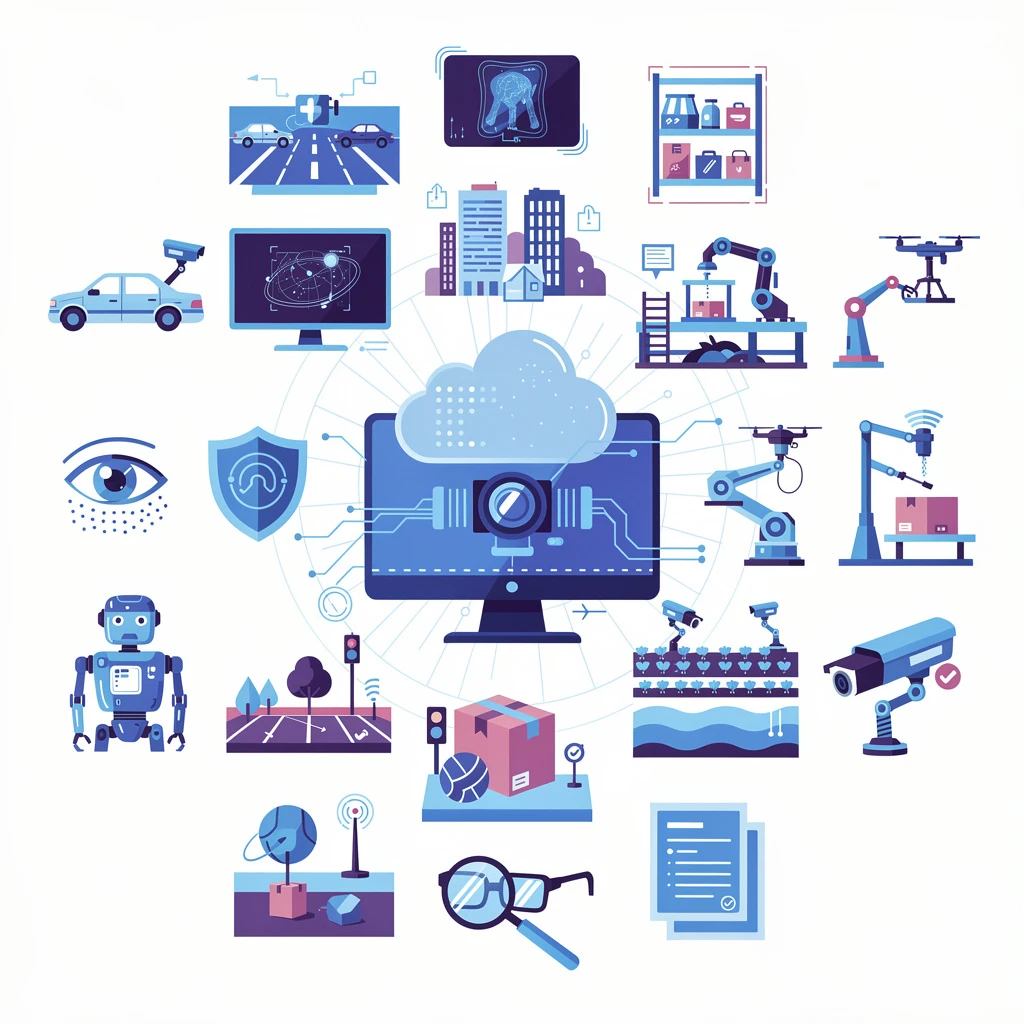
Computer vision applications represent one of the most rapidly evolving fields in artificial intelligence, enabling machines to interpret and understand visual information from the world around us. These applications are revolutionizing industries from healthcare to retail, manufacturing to transportation, creating unprecedented opportunities for automation and innovation.
With the global computer vision market projected to reach $41.11 billion by 2030, according to Grand View Research, understanding what is computer vision applications and their practical implementations has become crucial for businesses looking to stay competitive in the digital age.
What is Computer Vision?
Computer vision is a field of artificial intelligence that trains computers to interpret and understand visual information from digital images, videos, and real-world environments. It combines machine learning algorithms, deep learning neural networks, and image processing techniques to enable machines to “see” and make decisions based on visual data.
The technology works by:
- Image acquisition: Capturing visual data through cameras or sensors
- Pre-processing: Cleaning and preparing images for analysis
- Feature extraction: Identifying key visual elements and patterns
- Classification and detection: Recognizing objects, faces, or specific features
- Decision making: Taking action based on visual analysis
Core Components of Computer Vision Systems
Hardware Components
- Cameras and sensors: High-resolution imaging devices
- Processing units: GPUs and specialized AI chips
- Storage systems: For massive image datasets
- Edge computing devices: For real-time processing
Software Components
- Image processing libraries: OpenCV, PIL, scikit-image
- Machine learning frameworks: TensorFlow, PyTorch, Keras
- Pre-trained models: YOLO, ResNet, VGG — the foundation for transfer learning in computer vision, enabling high accuracy with minimal training data. These are convolutional neural networks — one of several types of neural networks used across AI applications. For a plain-English breakdown of what a convolutional neural network is and what convolutional layers actually do, see the CNN explainer. Or jump to our complete guide to CNN image classification for architecture comparisons and implementation approaches
- Custom algorithms: Tailored for specific applications
15 Revolutionary Computer Vision Applications
1. Healthcare and Medical Imaging
Computer vision is transforming medical diagnostics with unprecedented accuracy and speed.
Key Applications:
- Medical image analysis: CT scans, MRIs, and X-rays
- Cancer detection: Identifying tumors in mammograms and skin lesions
- Surgical assistance: Real-time guidance during operations
- Drug discovery: Analyzing molecular structures
Real-World Impact:
- Google’s AI system can detect diabetic retinopathy with 90% accuracy
- IBM Watson for Oncology assists in cancer treatment recommendations
- PathAI improves pathology diagnosis accuracy by 99.5%
2. Autonomous Vehicles and Transportation
Self-driving cars rely heavily on computer vision for navigation and safety.
Core Functions:
- Object detection: Identifying pedestrians, vehicles, and obstacles
- Lane detection: Maintaining proper road positioning
- Traffic sign recognition: Understanding road regulations
- Depth perception: Calculating distances to objects
Industry Leaders:
- Tesla’s Autopilot uses 8 cameras for 360-degree vision
- Waymo has logged over 20 million autonomous miles
- Uber’s self-driving trucks reduce transportation costs by 30%
3. Retail and E-commerce
Computer vision enhances shopping experiences and optimizes retail operations.
Applications:
- Visual search: Finding products by uploading images
- Inventory management: Automated stock monitoring
- Cashier-less stores: Amazon Go-style shopping
- Customer behavior analysis: Heat mapping and traffic patterns
Benefits:
- 30% reduction in inventory costs
- 25% increase in customer satisfaction
- 40% improvement in theft prevention
4. Manufacturing and Quality Control
Automated visual inspection ensures product quality and reduces defects.
Key Uses:
- Defect detection: Identifying flaws in products
- Assembly verification: Ensuring correct component placement
- Predictive maintenance: Monitoring equipment condition
- Safety compliance: Detecting unsafe working conditions
Results:
- 90% reduction in quality control time
- 95% accuracy in defect detection
- 50% decrease in production downtime
5. Agriculture and Farming
Precision agriculture uses computer vision for sustainable farming practices.
Applications:
- Crop monitoring: Assessing plant health and growth
- Pest detection: Early identification of crop diseases
- Yield prediction: Estimating harvest quantities
- Automated harvesting: Robotic fruit and vegetable picking
Impact:
- 20% increase in crop yields
- 30% reduction in pesticide usage
- 40% water conservation through precision irrigation
6. Security and Surveillance
Advanced monitoring systems provide enhanced security capabilities.
Features:
- Facial recognition: Identifying individuals in crowds
- Behavior analysis: Detecting suspicious activities
- Perimeter monitoring: Automated boundary security
- Vehicle tracking: License plate recognition
Statistics:
- 70% reduction in security incidents
- 85% accuracy in facial recognition systems
- 60% faster response times to threats
7. Entertainment and Media
Computer vision creates immersive experiences and content creation tools.
Applications:
- Augmented reality: AR filters and virtual try-ons
- Motion capture: Creating realistic animations
- Content moderation: Automatically flagging inappropriate content
- Sports analytics: Player performance tracking
8. Financial Services
Banking and finance leverage computer vision for security and efficiency.
Use Cases:
- Document processing: Automated check and form reading
- Fraud detection: Analyzing transaction patterns
- Identity verification: KYC compliance through facial recognition
- ATM security: Monitoring for suspicious activities
9. Construction and Architecture
Building industry applications improve safety and project management.
Applications:
- Progress monitoring: Tracking construction milestones
- Safety compliance: Detecting PPE violations
- Quality inspection: Identifying structural defects
- Site surveillance: 24/7 monitoring of construction sites
10. Education Technology
Enhancing learning experiences through visual intelligence.
Features:
- Automated grading: Scanning and evaluating handwritten tests
- Student engagement: Monitoring attention and participation
- Accessibility support: Assisting visually impaired students
- Proctoring solutions: Online exam supervision
11. Environmental Monitoring
Tracking environmental changes and conservation efforts.
Applications:
- Wildlife conservation: Animal behavior and population studies
- Pollution monitoring: Air and water quality assessment
- Disaster response: Damage assessment and rescue operations
- Climate research: Analyzing satellite imagery for climate patterns
12. Sports and Fitness
Optimizing athletic performance and fan engagement.
Uses:
- Performance analysis: Tracking player movements and statistics
- Injury prevention: Identifying risky movement patterns
- Fan experience: Interactive stadium features
- Broadcast enhancement: Automated camera following and highlights
13. Robotics and Automation
Enabling robots to navigate and interact with their environment.
Capabilities:
- Object manipulation: Precise handling of various items
- Navigation: Autonomous movement in complex environments
- Human-robot interaction: Understanding gestures and expressions
- Industrial automation: Assembly line optimization
14. Food Industry
Improving food safety and quality control processes.
Applications:
- Quality inspection: Detecting spoiled or contaminated food
- Sorting and grading: Automated classification of produce
- Portion control: Consistent serving sizes
- Nutritional analysis: Estimating caloric content from images
15. Real Estate and Property Management
Streamlining property evaluation and management processes.
Features:
- Property valuation: Analyzing visual features for pricing
- Virtual tours: 360-degree property exploration
- Damage assessment: Insurance claim processing
- Maintenance scheduling: Identifying repair needs
Key Benefits of Computer Vision Applications
Operational Advantages
- Increased efficiency: 40-60% faster processing times
- Reduced costs: 30-50% savings in manual labor
- Improved accuracy: 95%+ precision in automated tasks
- 24/7 availability: Continuous operation without breaks
Business Benefits
- Enhanced customer experience: Personalized interactions
- Competitive advantage: Early adoption of cutting-edge technology
- Scalability: Easy expansion across multiple locations
- Data-driven insights: Valuable analytics from visual data
Implementation Challenges and Solutions
Technical Challenges
-
Data quality and quantity
- Solution: Implement robust data collection and cleaning processes
- Use data augmentation techniques to expand datasets
-
Computing power requirements
- Solution: Leverage cloud computing and edge processing
- Utilize specialized AI hardware like GPUs and TPUs
-
Model accuracy and reliability
- Solution: Continuous training and model refinement
- Implement ensemble methods for improved performance
Business Challenges
-
High initial investment
- Solution: Start with pilot projects and scale gradually
- Consider cloud-based solutions to reduce upfront costs
-
Skills shortage
- Solution: Partner with AI specialists or invest in training
- Utilize pre-built solutions and APIs when possible
Getting Started with Computer Vision Applications
Step 1: Identify Use Cases
- Assess current business processes for automation opportunities
- Prioritize applications with highest ROI potential
- Consider regulatory and compliance requirements
Step 2: Evaluate Technology Options
- Pre-built solutions: Google Vision API, AWS Rekognition, Microsoft Computer Vision
- Open-source frameworks: TensorFlow, PyTorch, OpenCV
- Custom development: Tailored solutions for specific needs
Step 3: Develop Implementation Strategy
- Start with proof of concept projects
- Establish success metrics and KPIs
- Plan for data collection and management
- Ensure proper infrastructure and security measures
Step 4: Build and Deploy
- Collect and prepare training data
- Train and validate models
- Implement monitoring and maintenance processes
- Scale successful applications across the organization
Future Trends in Computer Vision
Emerging Technologies
- Edge computing: Real-time processing on device
- 3D computer vision: Depth perception and spatial understanding
- Multimodal AI: Combining vision with other senses
- Synthetic data: AI-generated training datasets
Industry Predictions
- 75% of enterprises will deploy computer vision by 2025
- Edge AI market will reach $59 billion by 2030
- Real-time video analytics will become standard
- Integration with IoT devices will accelerate
Conclusion
Computer vision applications are reshaping industries and creating new possibilities for automation, efficiency, and innovation. From healthcare diagnostics to autonomous vehicles, retail optimization to environmental monitoring, these technologies offer transformative potential for organizations willing to embrace them.
Success in implementing computer vision requires careful planning, appropriate technology selection, and a commitment to continuous improvement. As the technology continues to evolve, businesses that invest in computer vision capabilities today will be better positioned to compete in tomorrow’s AI-driven economy.
The key is to start with clear objectives, choose the right implementation approach, and build capabilities gradually while learning from each deployment. With proper execution, computer vision applications can deliver significant returns on investment while opening new avenues for growth and innovation.