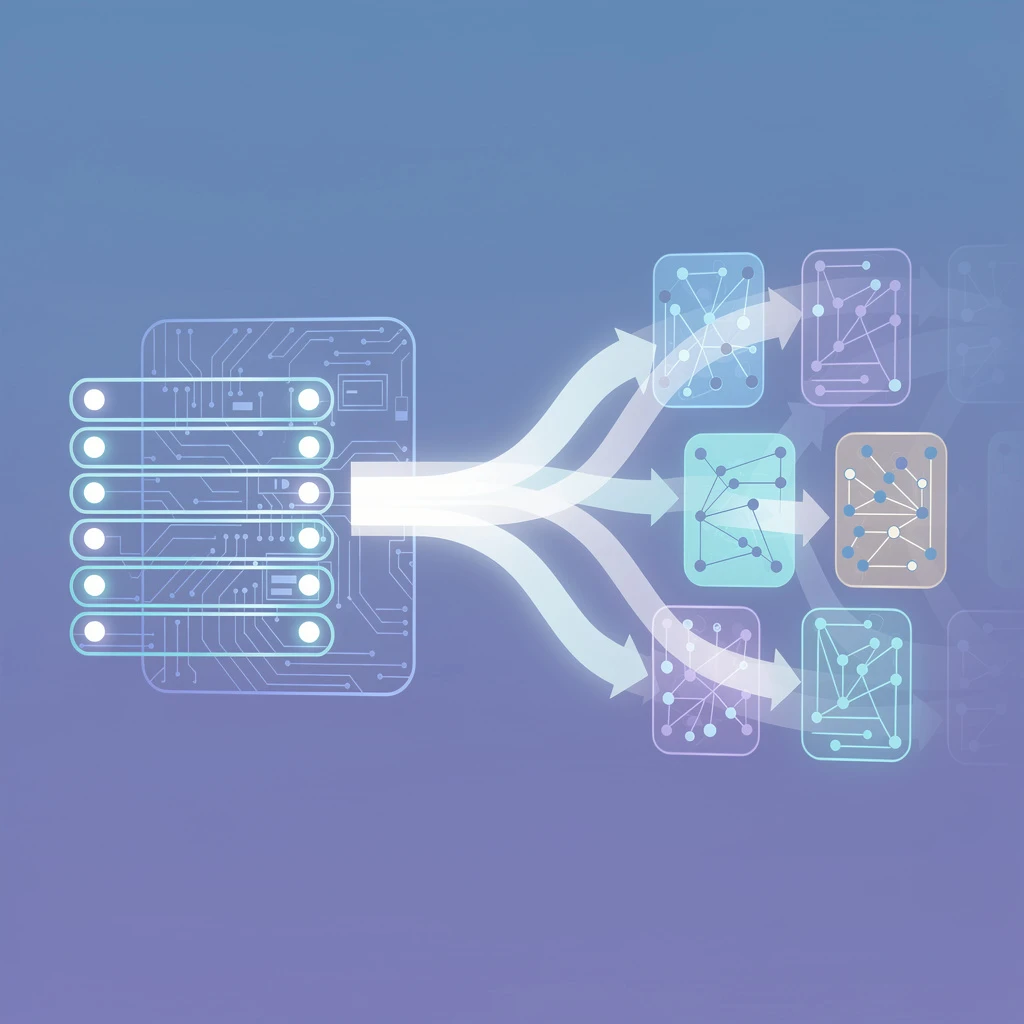
Training a deep learning model from scratch requires millions of labeled examples and weeks of GPU compute. Transfer learning eliminates both requirements — and it’s the reason most real-world AI deployments in 2026 are economically viable. As AutoML tools make transfer learning more accessible, understanding when and how to apply it is becoming a core differentiator for data science teams. For context on how AI is shifting data roles more broadly, see our analysis of whether data science will be replaced by AI.
The concept: take a model already trained on a massive dataset, adapt its learned representations to your specific problem, and produce a high-accuracy model in days rather than months. A 2023 survey by Hugging Face found that 87% of production ML deployments now start from a pre-trained checkpoint rather than random initialization.
This guide explains how transfer learning works, when to use it, and how to implement it for real business outcomes.
What Is Transfer Learning?
Transfer learning is a machine learning technique where knowledge gained while training on one task is reused to accelerate or improve learning on a different but related task.
The analogy is straightforward: a surgeon who learns anatomy, physiology, and sterile technique doesn’t start from zero when specializing in cardiac surgery — they transfer general medical knowledge and build on top of it. Transfer learning works the same way for neural networks.
The Problem Transfer Learning Solves
Training a large neural network requires three expensive resources:
- Labeled data: Supervised learning at scale needs tens of millions of annotated examples
- Compute: A ResNet-50 trained from scratch on ImageNet takes ~90 GPU-hours; GPT-3 cost roughly $4.6M in compute
- Time: Iteration cycles compress from months to days when you start from a pre-trained base
For most organizations, these costs make training from scratch impractical. Transfer learning changes the economics entirely. A 2022 Stanford analysis showed transfer learning approaches achieve equivalent performance to from-scratch training using 10-100× less labeled data.
Why Neural Networks Transfer Knowledge Well
Deep neural networks learn hierarchical representations. In a vision model:
- Early layers learn low-level features: edges, textures, color gradients — universal to any visual task
- Middle layers learn mid-level patterns: shapes, object parts, spatial relationships
- Final layers learn high-level abstractions: specific object classes, semantic concepts
The early and middle layers generalize across domains. A model pre-trained on ImageNet’s 1.2M images has already learned to detect edges, curves, and textures that are equally useful for medical imaging, satellite analysis, or retail product recognition. You don’t need to re-learn these representations — you fine-tune the top layers for your specific classes.
The same principle applies in NLP. Understanding how transformer models work reveals why BERT’s pre-training on 3.3 billion words of English text produces representations that transfer powerfully to downstream tasks like sentiment analysis, document classification, and named entity recognition.
How Transfer Learning Works
Transfer learning follows a consistent pipeline regardless of the domain.
The Standard Transfer Learning Workflow
| Step | Action | Purpose |
|---|---|---|
| 1. Select pre-trained model | Choose a model trained on a large, relevant dataset | Provides learned feature representations |
| 2. Remove final layers | Strip the task-specific classification head | Removes source-task specifics |
| 3. Freeze base weights | Lock the pre-trained layers (optional) | Preserves learned representations |
| 4. Add new layers | Attach new classification/regression head | Targets your specific task |
| 5. Train on target data | Update new (and optionally base) layer weights | Adapts to your domain |
| 6. Evaluate and iterate | Test on held-out set, adjust learning rate | Validates transfer quality |
Feature Extraction vs. Fine-Tuning
The two main transfer learning strategies differ in how much of the pre-trained model you retrain:
Feature Extraction (frozen base):
- All pre-trained layers are frozen — their weights do not update
- Only the new classification head is trained
- Best for: Small datasets (<500 examples per class), limited compute, high similarity to pre-training domain
- Result: Faster training, lower risk of overfitting, but ceiling on task-specific performance
Fine-Tuning (unfrozen base):
- Pre-trained weights are used as initialization but can be updated
- Training continues at a low learning rate (typically 10-100× smaller than standard)
- Best for: Moderate to large datasets, domain dissimilarity requiring adaptation, maximum accuracy requirements
- Result: Higher performance potential, higher compute cost, higher risk of catastrophic forgetting if learning rate is too large
A common hybrid approach: freeze the first 70% of layers (the most generalizable features), fine-tune the last 30% along with the new head. This delivers most of the performance gain of full fine-tuning at a fraction of the compute cost.
Understanding Catastrophic Forgetting
The primary failure mode of fine-tuning is catastrophic forgetting — the network overwrites valuable pre-trained representations with task-specific information, destroying the generalization that made transfer learning valuable in the first place.
Three techniques prevent it:
- Low learning rate: Use 1e-5 to 1e-4 for fine-tuning vs. 1e-3 for training from scratch
- Layer-wise learning rate decay: Apply progressively smaller learning rates to earlier layers
- Elastic Weight Consolidation (EWC): A regularization technique that penalizes large changes to weights important for previous tasks
Understanding these mechanics also informs how you’d approach training machine learning models from scratch — the hyperparameter logic carries over directly.
Ready to deploy transfer learning in your business? GrowthGear has helped 50+ companies build custom AI models using pre-trained foundations — cutting time-to-production from months to weeks. Book a Free Strategy Session to scope your transfer learning project.
Transfer Learning Techniques and Approaches
Domain Adaptation
Domain adaptation addresses the case where the source and target domains differ in data distribution but share the same task. Example: a sentiment classifier trained on Amazon reviews applied to financial news sentiment.
The challenge is domain shift — the statistical properties of the data differ, so features that worked in the source domain may not transfer cleanly. Techniques include:
- Adversarial domain adaptation: Train a domain classifier alongside the task model, using adversarial training to learn domain-invariant features
- Instance weighting: Upweight source examples that resemble the target distribution
- Distribution alignment: Minimize the statistical distance (e.g., Maximum Mean Discrepancy) between source and target feature distributions
For NLP tasks, domain-adaptive pre-training — continuing BERT’s masked language modeling on target-domain text before fine-tuning — reliably improves downstream performance by 2-8% on specialized domains like legal, medical, or financial text.
Multi-Task Learning
Rather than sequential transfer (pre-train → fine-tune), multi-task learning trains on multiple related tasks simultaneously, sharing representations across them.
Google’s T5 (“Text-To-Text Transfer Transformer”) exemplifies this approach: it frames every NLP task as text generation, training on translation, summarization, classification, and Q&A simultaneously. The shared representations are more general and transfer more robustly than single-task pre-training.
For business applications, multi-task learning is valuable when you have multiple related prediction problems (e.g., simultaneously classifying customer intent, extracting entities, and predicting churn from support tickets) and limited labeled data for each.
Zero-Shot and Few-Shot Transfer
Modern large language models demonstrate zero-shot transfer — performing tasks they were never explicitly trained on, guided only by natural language descriptions. GPT-4 can classify documents, extract structured data, or answer domain-specific questions without any fine-tuning, simply by describing the task in the prompt.
Few-shot learning provides a small number of examples (3-32 “shots”) in the prompt to steer the model’s behavior. For tasks where labeled data is expensive to collect, few-shot prompting of a powerful LLM often matches fine-tuned smaller models at a fraction of the data and compute cost.
The practical decision rule: if GPT-4 or Claude with a well-crafted prompt achieves your target accuracy, the infrastructure complexity of fine-tuning may not be worth it. If the task is highly specialized, requires low latency, or has privacy constraints, fine-tune a smaller model. For a dedicated guide on the mechanics of fine-tuning — covering LoRA, QLoRA, RLHF, infrastructure options, and cost benchmarks — see what is fine-tuning in deep learning.
Business Applications of Transfer Learning
Computer Vision: Industrial Quality Control
Traditional quality control required manufacturing firms to collect thousands of defect images per product variant — an expensive, multi-month data collection process before any model could be trained.
With transfer learning from ImageNet-pre-trained models like EfficientNet or ResNet-50:
- Manufacturers achieve >95% defect detection accuracy with as few as 200-500 images per defect category
- Deployment timelines compress from 6-12 months to 4-8 weeks
- The same base model can be re-fine-tuned for each new product line in days, not months
A Nature paper on transfer learning in industrial inspection documented 40% accuracy improvements over from-scratch models on small manufacturing datasets.
This is directly relevant to the broader computer vision applications landscape — virtually every modern production computer vision system starts from a pre-trained backbone. Teams that want to validate a visual classification problem before committing to production infrastructure can start with Google Teachable Machine, which applies MobileNet-based transfer learning through a browser interface with no code required—typically producing a proof-of-concept model in under 20 minutes.
NLP: Customer Intelligence at Scale
B2B companies generate enormous volumes of unstructured text: support tickets, call transcripts, CRM notes, contract documents. Transfer learning makes it economically viable to extract structured insights from this data:
- Sentiment and intent classification: Fine-tune BERT on 500-1,000 labeled tickets → 92%+ accuracy routing classifier
- Named entity extraction: Fine-tune on 200 annotated documents → extract product names, dates, obligations from contracts
- Churn prediction signals: Fine-tune on labeled call transcripts → surface at-risk accounts before they churn
The ROI compounds: companies that use AI-driven customer intelligence see 20-35% improvements in qualified pipeline and measurably lower churn rates. Pairing transfer learning models with effective B2B lead generation strategies creates a data-driven growth flywheel.
Healthcare: Medical Imaging with Limited Data
Medical imaging exemplifies transfer learning’s value in data-scarce, high-stakes environments:
- A hospital may have only 500 labeled chest X-rays for a specific pathology
- Training from scratch on 500 examples produces a model that barely beats random chance
- Fine-tuning from a model pre-trained on CheXpert (224,000 chest X-rays) achieves clinically useful accuracy on the same 500 examples
The Google DeepMind AlphaFold 2 paper demonstrated that large-scale pre-training on protein sequences, combined with fine-tuning on structure data, achieved breakthrough accuracy in protein structure prediction — a problem the field had worked on for 50 years.
Marketing: Content Personalization at Scale
Transfer learning powers the recommendation and personalization engines that drive revenue for content-heavy businesses:
- Semantic search: Fine-tuned sentence embeddings power “find similar articles” features with dramatically better relevance than keyword matching
- Content tagging automation: Fine-tune on 300-500 tagged examples → auto-tag new content with 90%+ accuracy
- Ad targeting: Transfer learning models classify user intent from behavioral sequences, improving click-through rates by 15-30%
Organizations deploying AI-powered content personalization consistently see higher organic traffic and improved conversion rates as content reaches more relevant audiences. Our sister site covers the full marketing automation stack in detail.
Take the Next Step
Transfer learning removes the biggest barriers to custom AI — data requirements, compute costs, and time-to-value. Whether you’re exploring your first ML project or scaling an existing AI initiative, starting from a pre-trained foundation is almost always the right decision.
GrowthGear has helped companies across manufacturing, SaaS, and professional services deploy transfer learning models that deliver measurable outcomes. Our team combines technical depth with commercial clarity, so your AI investment is scoped to what actually moves the needle.
Book a Free Strategy Session →
How to Implement Transfer Learning
Choosing the Right Pre-Trained Model
Your starting point determines your ceiling. Match the pre-training domain to your target domain:
| Your Task | Recommended Pre-Trained Model | Source |
|---|---|---|
| Image classification/detection | ResNet-50, EfficientNet-B4, ViT-B/16 | ImageNet pre-training |
| Medical imaging | CheXNet, Med-SAM, BioViL-T | Medical dataset pre-training |
| General NLP | BERT-base, RoBERTa-base | Wikipedia + BookCorpus |
| Long-document NLP | Longformer, BigBird | Long-document corpora |
| Code tasks | CodeBERT, StarCoder | GitHub source code |
| General LLM tasks | LLaMA 3, Mistral 7B | General web text |
For vision tasks, the PyTorch transfer learning tutorial provides a production-ready reference implementation. For NLP, the TensorFlow transfer learning guide covers the full fine-tuning pipeline.
The Fine-Tuning Checklist
Before starting a fine-tuning run, validate:
- Data quality: Mislabeled examples hurt fine-tuning more than from-scratch training, since the model already has strong priors that noisy labels must overcome
- Label distribution: Class imbalance degrades fine-tuned models quickly; target a 5:1 maximum ratio between most and least common classes
- Validation set independence: Your validation set must not leak into training through any preprocessing steps
- Learning rate: Start at 2e-5 for BERT-based models, 1e-4 for vision models; use a learning rate finder if unsure
- Epochs: Fine-tuning typically needs 3-10 epochs; more risks catastrophic forgetting
Evaluating Transfer Learning Quality
Three signals tell you whether transfer learning is working:
1. Learning curve shape: In successful transfer learning, validation accuracy increases rapidly in epoch 1-2 and plateaus. In from-scratch training, learning curves are gradual. If your fine-tuned model shows a slow learning curve, the pre-trained model may not be domain-compatible.
2. Layer activation analysis: Visualize activations in early, middle, and final layers. Early layers should show the same low-level features as the pre-trained model; final layers should show task-specific patterns.
3. Benchmark comparison: Compare against a baseline fine-tuned on a subset of data vs. trained from scratch on the full dataset. Transfer learning should match or beat the from-scratch baseline using significantly less data.
Practical Cost Benchmarks
| Task | From-Scratch Cost | Transfer Learning Cost | Speedup |
|---|---|---|---|
| Image classifier (10 classes, 1K images) | 40-80 GPU-hours | 2-4 GPU-hours | 20× |
| NLP text classifier (5 classes, 2K examples) | 100+ GPU-hours | 1-3 GPU-hours | 50× |
| Named entity recognizer | 200+ GPU-hours | 2-5 GPU-hours | 60× |
| Object detection (custom classes) | 150+ GPU-hours | 8-15 GPU-hours | 15× |
These benchmarks assume NVIDIA A100-class GPUs. At current cloud rates (~$2-3/GPU-hour), transfer learning reduces compute costs from $300-600 to $6-45 for typical production tasks.
For teams evaluating broader AI tool ecosystems for business, transfer learning capabilities are now table-stakes features in enterprise ML platforms like Vertex AI, SageMaker, and Azure ML.
Frequently Asked Questions
Transfer learning reuses a model trained on one task as the starting point for a different but related task. Instead of training from scratch, you adapt pre-trained weights, cutting training time by 60-90% and requiring far less labeled data.
Feature extraction freezes the pre-trained layers and only trains the final classifier on your data. Fine-tuning unfreezes some or all layers and continues training at a low learning rate, allowing deeper adaptation to your domain.
Transfer learning works with as few as 100-1,000 labeled examples per class, compared to millions needed to train from scratch. The less similar your domain to the pre-training domain, the more data you'll need for fine-tuning.
For vision: ResNet-50, EfficientNet, and Vision Transformer (ViT). For NLP: BERT, RoBERTa, and GPT-based models. For general tasks: Meta's LLaMA and Mistral are popular open-source options for fine-tuning.
Transfer learning reduces AI project costs by 60-80%, cuts time-to-production from months to weeks, and enables high-accuracy models without large labeled datasets — making custom AI viable for mid-market companies.
Yes. When source and target domains are too dissimilar, pre-trained weights can hurt rather than help. The fix is to fine-tune fewer layers or use a more domain-relevant pre-trained model as your starting point.
Healthcare (medical imaging with <1,000 scans), manufacturing (defect detection), retail (product recognition), and fintech (document processing) see the highest transfer learning ROI due to limited labeled data availability.