Key Takeaways
- Transformers process all tokens in parallel via self-attention, solving the sequential bottleneck of RNNs
- Multi-head attention lets the model capture different relationship types simultaneously
- Most businesses should use API access to frontier models rather than training from scratch
- Year 2 is when transformer deployment ROI compounds -- treat it as workflow transformation, not a chatbot addition
Evaluate on Your Own Data, Not Public Leaderboards
The 2017 paper “Attention Is All You Need” introduced a single architectural idea that made GPT-4, Claude, Gemini, and virtually every modern AI system possible. That architecture is the transformer.
Understanding what a transformer does — and why it outperforms everything that came before — gives you a genuine advantage when evaluating AI tools, building AI-powered products, or having honest conversations with vendors. This guide explains transformers from first principles, without requiring a maths degree.
The Transformer Architecture Explained
The Core Problem Transformers Solve
Before transformers, the dominant architecture for sequence data (text, audio, time-series) was the Recurrent Neural Network (RNN). RNNs read input one token at a time and carry a hidden state forward, like reading a book and trying to summarize each sentence while partially forgetting earlier chapters.
Two failure modes plagued RNNs:
- Vanishing gradients: Information from early tokens would fade before reaching the end of long sequences
- Sequential bottleneck: Tokens had to be processed one after another, making parallelization and GPU utilization near-impossible
Transformers solve both problems by abandoning sequential processing entirely.
The Three Core Components
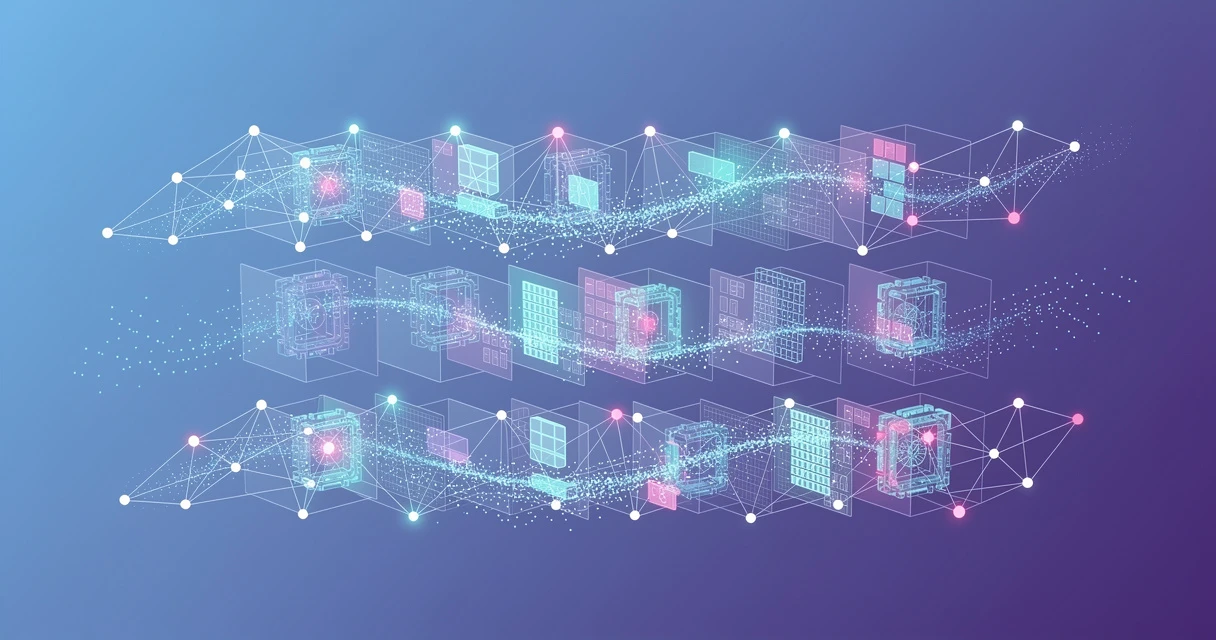
A transformer block has three key components working together:
| Component | What it does |
|---|---|
| Multi-head self-attention | Lets every token look at every other token simultaneously |
| Feed-forward network | Applies a non-linear transformation to each token’s representation |
| Layer normalization | Stabilizes training by normalizing activations within each layer |
These blocks are stacked — GPT-2 had 48 layers, GPT-3 had 96, and the largest models today run into the hundreds. The depth creates hierarchical representations: early layers learn syntax, middle layers learn semantics, and late layers learn complex reasoning patterns. This layered architecture follows the same core deep learning principles described in how deep learning works. Running these stacked layers on new data in production — the process known as machine learning inference — is where optimizing latency and cost becomes the primary engineering challenge.
Not every transformer uses a single dense feed-forward block per layer, though. Models like Mixtral and DeepSeek-V3 swap that block for multiple specialized sub-networks and a router that activates only a few per token — see mixture of experts vs dense models for how that tradeoff changes memory footprint, training complexity, and serving cost.
Encoder vs. Decoder Transformers
The original architecture had two halves:
- Encoder (e.g., BERT): Reads the full input bidirectionally and builds a rich representation. Best for classification, question answering, and understanding tasks. See what is BERT in NLP for BERT’s architecture, variants, and business deployment guide.
- Decoder (e.g., GPT): Generates output autoregressively, predicting one token at a time while attending to previous tokens. Best for generation tasks.
Most modern frontier LLMs (GPT-4, Claude, Llama) are decoder-only architectures. Models like T5 and Gemini use encoder-decoder for tasks that require both understanding and generation. For a practical breakdown of what this architecture means specifically for ChatGPT — including how pretraining and RLHF layer on top of the base transformer — see is ChatGPT a neural network?. For a broader comparison covering all LLM variants — decoder-only, encoder-only (BERT), and encoder-decoder (T5) — with guidance on choosing between them for your use case, see do LLMs use neural networks: the architecture explained.
How Transformers Work: Attention Mechanisms
Self-Attention Step by Step
Self-attention is the mechanism that gives transformers their power. For each token in the sequence, the model learns three vectors:
- Query (Q): “What am I looking for?”
- Key (K): “What do I offer?”
- Value (V): “What information should I pass on?”
The attention score between two tokens is the dot product of Q and K, scaled and passed through a softmax. High scores mean the model decides those two tokens are strongly related — “Paris” and “capital” will have high attention toward each other in the phrase “Paris is the capital of France.”
Formally: Attention(Q, K, V) = softmax(QK^T / √d_k) V
The key insight: this computation runs in parallel for all token pairs simultaneously, not sequentially. That’s why transformers train in hours on GPUs that would have taken months for equivalent RNNs.
Multi-Head Attention
A single attention head captures one type of relationship. Multi-head attention runs several attention heads in parallel, each learning different relationship types:
- One head might track subject-verb agreement
- Another tracks coreference (connecting pronouns to their nouns)
- Another tracks sentiment context
GPT-3 uses 96 attention heads per layer. The outputs from all heads are concatenated and projected back to the model’s working dimension. For a complete technical breakdown of QKV scoring, attention variants (self-attention, cross-attention, Flash Attention), and how context window size is constrained by attention complexity, see our attention mechanism in deep learning guide. For a focused deep-dive on the parallel-head computation, head count selection, and Multi-Query/Grouped-Query Attention variants, see what is multi-head attention in deep learning. For a deeper dive into how these language capabilities power business tools, see our guide to what is natural language processing.
Positional Encoding
Because transformers process all tokens simultaneously, they have no built-in sense of order. Positional encoding solves this by adding a position-dependent signal to each token embedding before the first layer.
The original paper used fixed sinusoidal encodings. Most modern models use learned positional embeddings or Rotary Position Embedding (RoPE), which scales more gracefully to long contexts. Llama 3 and Mistral use RoPE, enabling context windows of 128K tokens or more.
Ready to implement AI transformer models in your business? GrowthGear’s team has helped 50+ startups integrate LLMs and NLP solutions that drive measurable results. Book a Free Strategy Session to discuss which transformer models fit your use case.
Transformers vs. Earlier Neural Networks
The RNN Family: What Transformers Replaced
Before transformers, practitioners reached for three architectures:
Vanilla RNNs: Simple recurrent networks that accumulated hidden states. Effective for short sequences; collapsed on anything longer than ~50 tokens.
LSTMs (Long Short-Term Memory): Added gating mechanisms to control what to remember and forget. State-of-the-art for NLP from ~2014–2017. Still used for time-series and edge deployments where model size matters.
GRUs (Gated Recurrent Units): A lighter LSTM variant. Faster to train, slightly worse on very long sequences.
All three share the same fundamental bottleneck: sequential processing and a single fixed-size hidden state as the only “memory.”
Benchmark Comparison
| Architecture | Parallelizable | Long-range dependencies | Training speed | Dominant use case |
|---|---|---|---|---|
| Vanilla RNN | No | Poor | Slow | Deprecated |
| LSTM | No | Moderate | Moderate | Edge/embedded |
| CNN (1D) | Yes | Limited | Fast | Short sequences |
| Transformer | Yes | Excellent | Fast | All sequence tasks |
Understanding these tradeoffs is essential when choosing architectures for your own ML projects. For a comprehensive breakdown of all major network families — CNNs, RNNs, LSTMs, GANs, and more — see our complete guide to types of neural networks. Our guide on how to train machine learning models covers the practical setup decisions in detail.
Convolutional Neural Networks and Vision Transformers
CNNs dominated computer vision throughout the 2010s by exploiting the local spatial structure of images with convolutional filters. They’re still efficient for embedded vision tasks. But Vision Transformers (ViT), introduced by Google in 2020, proved that splitting images into patches and treating them as token sequences achieves state-of-the-art accuracy at scale.
Modern multimodal models (GPT-4V, Gemini, Claude 3) combine vision encoders with language decoders — the full power of transformers applied to both modalities simultaneously. This is directly relevant to understanding computer vision applications in production systems.
Business Applications of Transformer Models
Where Enterprises Are Deploying Transformers Now
According to McKinsey’s State of AI report, 79% of respondents had been exposed to generative AI in 2023, with adoption accelerating sharply in 2024–2025. The business applications fall into five categories:
1. Document intelligence Transformers read contracts, invoices, and technical documents faster than any human team. Companies like Klarna use LLMs to process legal documents at a fraction of traditional legal review costs.
2. Customer service automation Conversational AI powered by decoder transformers now handles 40–80% of Tier 1 support tickets for large enterprises, with satisfaction rates exceeding human agents on structured queries. For a detailed comparison of tools, see our article on best AI chatbots for customer service.
3. Code generation GitHub Copilot (GPT-4 based) reports that developers accept approximately 30% of its suggestions and complete tasks 55% faster. Developer productivity tooling is now the highest-ROI transformer deployment category for engineering teams.
4. Marketing and content operations Transformers generate first-draft content, localize materials across languages, and run multivariate A/B testing on copy at scale. When combined with proper workflow design, content production costs drop 60–80%. Explore AI tools for digital marketing automation for specific tool recommendations.
5. Sales intelligence LLMs parse CRM data, summarize call transcripts, and generate personalized outreach at scale. The average B2B sales team using AI-assisted prospecting sees 20–35% more qualified pipeline. See how this pairs with B2B lead generation strategies for the full picture.
The ROI Calculation
GrowthGear has advised 50+ startups on AI implementation. The pattern for transformer deployment ROI is consistent:
- Year 1: Integration and workflow redesign eat most of the savings. Break-even is typical.
- Year 2: Compounding productivity gains kick in. 3–5× ROI is common for document-heavy workflows.
- Year 3+: Data flywheel effects appear — fine-tuned models on proprietary data significantly outperform generic models.
The firms that see 156% growth outcomes are those that treat AI as a workflow transformation, not a chatbot addition.
Choosing the Right Transformer Model
The Model Landscape in 2026
| Model | Provider | Context window | Best for |
|---|---|---|---|
| GPT-4o | OpenAI | 128K tokens | General-purpose, multimodal |
| Claude 3.5 Sonnet | Anthropic | 200K tokens | Long documents, coding, analysis |
| Gemini 1.5 Pro | 1M tokens | Very long context, multimedia | |
| LLaMA 3.3 70B | Meta (open) | 128K tokens | On-premise, fine-tuning |
| Mistral Large | Mistral AI | 128K tokens | European data residency |
| Phi-4 | Microsoft | 16K tokens | Edge deployment, low cost |
Build vs. Buy vs. Fine-Tune
API access (buy): Right for 80% of businesses. No infrastructure, pay-per-token, immediate access to frontier capabilities. Costs $500–$5,000/month for typical enterprise workloads.
Fine-tuning: Right when you have 1,000+ domain-specific examples and generic models underperform. Fine-tuning GPT-4o or Claude costs $10,000–$50,000 in compute and yields 20–40% quality improvement on targeted tasks. Transfer learning techniques make fine-tuning far more economical than training from scratch — cutting compute requirements by 15–60×.
Training from scratch: Reserved for well-resourced labs. A 7B parameter model costs ~$200,000 in compute. Most businesses have no reason to go here.
The decision mirrors the build-vs-buy logic covered in our guide on how to implement AI in business.
Evaluating Transformer Models
Before committing to a vendor, evaluate on:
- Task-specific benchmarks: Run your own eval set, not just public leaderboards (which models are often optimized for)
- Context faithfulness: Does the model use long context reliably or hallucinate? Test with 50K+ token documents
- Latency at scale: Time-to-first-token and throughput matter for user-facing apps
- Data handling: Where is your data processed and stored? Critical for regulated industries
- Cost at volume: Frontier models are expensive at scale; calculate break-even against fine-tuned open-source options
The Hugging Face Transformers library is the practical starting point for evaluating and deploying open-source models — it supports 400+ architectures with a unified API.
Take the Next Step
Transformer models are not a technology trend — they are the foundational infrastructure of the next decade of software. Whether you are evaluating your first LLM API, building a fine-tuned model on proprietary data, or redesigning workflows around AI-native processes, the architecture decisions you make now compound over time.
GrowthGear has helped businesses across industries move from “exploring AI” to deploying transformers that measurably improve margins. Our team brings both the technical depth to evaluate architectures and the commercial experience to prioritize the right use cases.
Book a Free Strategy Session →
Frequently Asked Questions
A transformer is a deep learning architecture that uses self-attention mechanisms to process sequences of data in parallel. Introduced in 2017, transformers power modern LLMs like GPT-4, Claude, and Gemini.
The attention mechanism lets a transformer weigh the relevance of every word in a sequence against every other word simultaneously, capturing long-range dependencies that earlier RNN models struggled with.
RNNs process sequences one token at a time sequentially. Transformers process all tokens in parallel using self-attention, making them faster to train and better at capturing distant relationships in text.
The most widely used transformers include GPT-4 (OpenAI), Claude (Anthropic), Gemini (Google), BERT (Google), LLaMA (Meta), and Mistral. Each has different strengths in reasoning, coding, or language tasks.
Yes. Vision Transformers (ViT) apply the architecture to images, audio transformers handle speech, and models like AlphaFold 2 use transformers for protein structure prediction.
Costs range from $0.002 per 1K tokens for API access (e.g., GPT-4o Mini) to millions of dollars to train a frontier model from scratch. Most businesses use API access and spend $500–$5,000/month.
Not for inference. All major LLM providers offer cloud APIs requiring no GPU. You only need significant compute if you are fine-tuning or training a model, which most businesses outsource to cloud providers.